
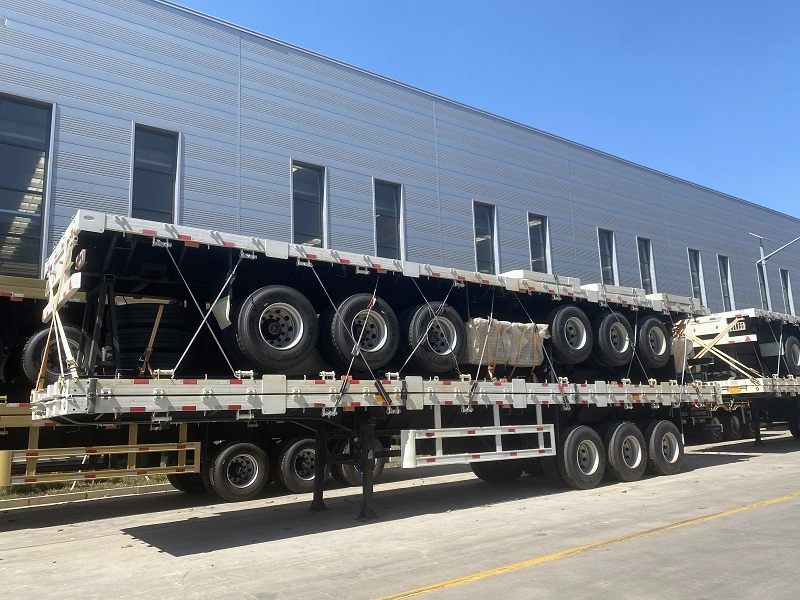
Flatbed semi trailers have different load capacities and are suitable for transporting various types of goods, but if you think that Flatbed semi trailers are just different in size, you are wrong. If you want to know more about Flatbed semi trailers, you must first understand their braking methods. This article will explain the braking methods of Flatbed semi trailers in detail.
1. Pneumatic braking
When the driver steps on the brake pedal, the brake valve opens, and compressed air enters the brake chamber through the pipe, pushing the brake shoe to contact the brake drum, generating friction, thereby achieving braking. This is pneumatic braking, which is one of the most common braking methods in Flatbed semi trailers. It has the advantages of simple structure, good braking effect, and easy maintenance. It is very suitable for vehicles transporting heavy objects.
2. Hydraulic braking
Hydraulic braking systems are also used on some small Flatbed semi trailers. It uses hydraulic oil as a power source, which is transmitted through hydraulic pumps and pipelines to achieve braking. Although this braking method is sensitive and has uniform braking force, it is not suitable for heavy vehicles. Some small, light-loaded Flatbed semi trailers may use it.
3. ABS anti-lock braking
ABS detects the rotation speed of the wheel through a sensor. When it detects that a wheel is about to lock, the ECU will control the solenoid valve to quickly adjust the braking force of the wheel to prevent the wheel from locking, maintain the stability of the vehicle, and avoid planning and loss of control.
4. Auxiliary braking
In addition to the above main braking methods, Flatbed semi trailers are also equipped with some auxiliary braking systems, such as engine braking, exhaust braking, etc. These auxiliary braking systems can help reduce the burden of the main braking system in downhill or heavy-loaded conditions, and improve braking effect and safety.