
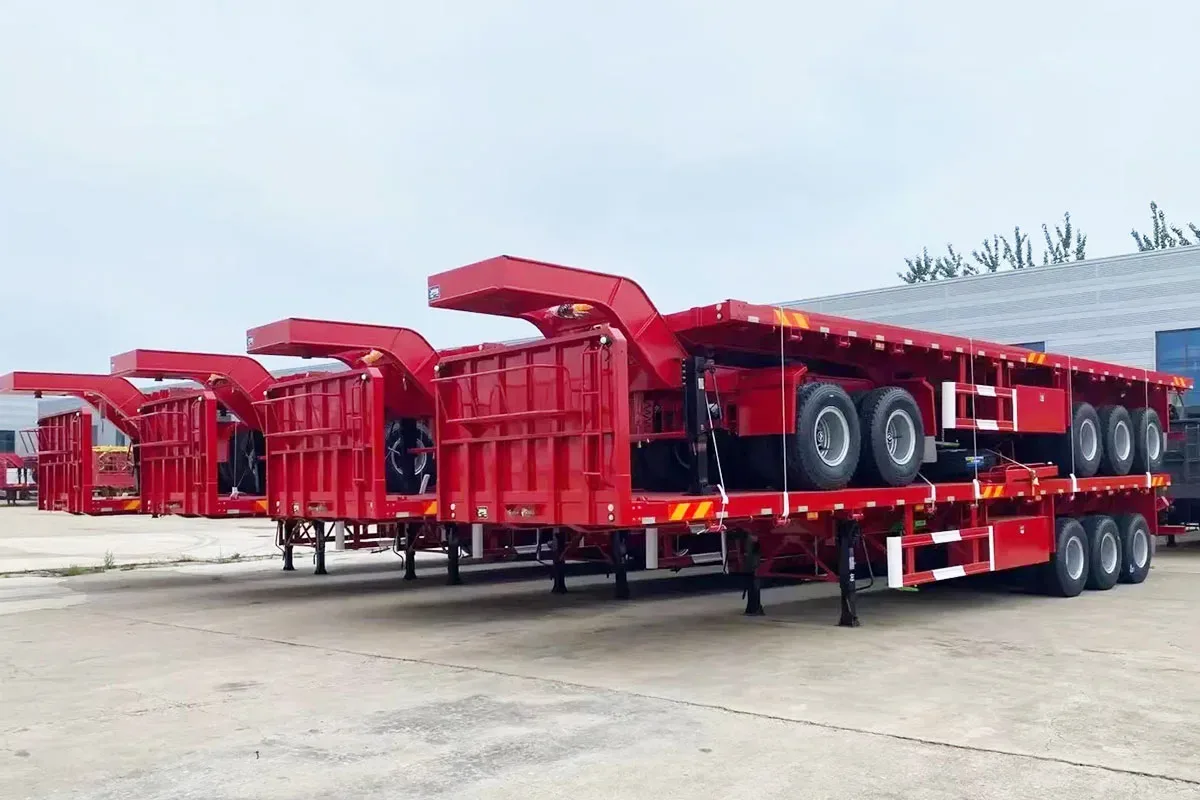
Everyone knows how important brakes are for a moving vehicle. For a heavy vehicle like a flatbed semi trailer, it is not something that can be neglected. So what are the braking techniques in normal driving? Let’s take a look at the braking techniques and daily maintenance of the brakes for flatbed semi trailers.
It is important for novice flatbed semi trailer drivers to drive with their feet. Many novice flatbed semi trailer drivers are used to stepping on the brakes lightly with their feet. Under normal circumstances, there is nothing wrong with this action; but in an emergency, it is likely that the car will not be able to be braked immediately.
This is because the action of using the foot to brake is not as fast as using the sole of the foot, which can instantly step on the entire brake pedal to the bottom and exert the braking ability. The correct way to step on the brake is to develop the habit of stepping on the brake with the force between the foot and the sole of the foot.
At this time, if the speed is too fast and the semi-trailer does not have an ABS anti-lock braking system, it is likely that after the brakes are stepped on, the tires will bite and the direction of travel cannot be controlled. The driving level can be seen from the way a person usually operates the brakes.
Stopping the car suddenly as soon as you step on the brakes, or failing to stop when you should, are not the performance of a driver. Novice trailer drivers often pay attention to the brakes of the car. We should adjust the speed before turning. Braking, shifting, pumping oil.
In case of an emergency, such as suddenly noticing an obstacle, you should immediately stop the tilting action, straighten the body bar, and then brake. When the speed is slightly slower, tilt the body to turn. To put it simply, it is to stop turning, brake, and turn again. The braking of a semi-trailer downhill depends on skill.
First, lightly step on the tail wheel and then squeeze the front brake to prevent the front of the car from sinking too much, actively increase the weight of the tail wheel, and avoid adding pressure on the pressure rod. Use the throttle skillfully. In addition to the foot brake, you should also use the throttle to control the speed. In the case of distance, once you need to slow down, just release the throttle, and properly cooperate with the foot brake to easily control the speed.
In addition to mastering the braking skills, drivers of flatbed semi trailers should always check whether the brake system of the flatbed semi trailer is intact.
1. Is the brake fluid within the range? Many trailer manuals require that the brake fluid be changed regularly. This requirement of the manufacturer is somewhat conservative, but it is for the safety of the owner.
2. Because the brake fluid has been used for a long time, it will decrease to some extent, thereby reducing the braking. There is another main reason. If there is air in the brake fluid, even a small amount of air, it will greatly reduce the braking.
3. Whether the trailer brake pads meet the requirements. When the brake pads are worn to a certain extent, the braking will decrease significantly, and it is time to replace the brake pads. In addition, even a crack in the brake pads will directly affect the braking.
4. Check the road conditions. In weather conditions such as ice, snow, and rain, the road becomes very slippery and the braking distance will be greatly extended. In addition, roads with too much sand, gravel, and even dust will also reduce the braking.
5. The braking of asphalt roads and concrete roads is also different. Under the same conditions, the braking of asphalt roads is better than that of concrete roads.
Whether the brake system of a flatbed semi trailer is intact directly determines the safety of the driver, so it is necessary to regularly check and maintain the brake system of the semi-trailer.
Not only novice flatbed semi trailer drivers need to keep this in mind, but drivers who often drive flatbed semi trailers should also standardize their operations. Develop good driving habits to prevent accidents before they happen.