
When choosing a Flatbed semi trailer, we often see terms such as 3-axle, 4-axle and 5-axle mentioned in the introduction. For novice friends, these terms may not be easy to understand. Today, we will introduce the issue of the number of axles of Flatbed semi trailers in detail to help you better choose the model that suits you.
What is the number of axles of a Flatbed semi trailer?
First of all, we need to understand the concept of the number of axles of a Flatbed semi trailer. Simply put, the number of axles is how many pairs of tires there are under the vehicle, including the connecting axles between each pair of tires. The number of axles is one of the important parameters of a semi-trailer. It not only affects the carrying capacity of the vehicle, but also affects the driving stability and safety of the vehicle.
Usually, the vehicles we see have different configurations such as single axle (one pair of tires), double axle (two pairs of tires) and multi-axle (three pairs or more pairs of tires). Knowing these basic concepts, we can better understand the difference between 3-axle, 4-axle and 5-axle Flatbed semi trailers.
The difference between 3-axle, 4-axle and 5-axle Flatbed semi trailers
Generally speaking, the more axles there are, the higher the vehicle’s carrying capacity and driving stability, but it also means higher production costs and fuel consumption.
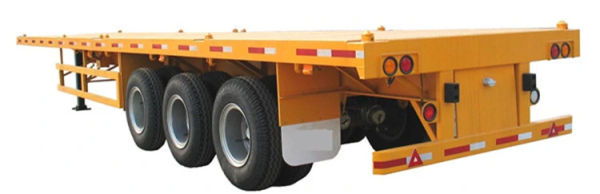
1. Three-axle trucks
Three-axle trucks have three axles, usually including two drive axles and one driven axle. It can carry a relatively large weight and has good driving stability. Three-axle trucks are widely used in cargo transportation, especially on urban roads and highways.
2. Four-axle trucks
Four-axle trucks have four axles, usually including two drive axles and two driven axles. It can carry a larger weight while providing better driving stability and handling. Four-axle trucks are often used for heavy loads or long-distance transportation.
3. Five-axle trucks
Five-axle trucks have five axles, including more drive axles and driven axles. This allows the truck to carry a very large weight while maintaining the stability and driving safety of the vehicle. Five-axle trucks are often used for special heavy-load tasks, such as large equipment transportation.
Example
Take the 40-foot 3-axle container Flatbed semi trailer of LIONKAR Semi-trailer as an example. This is a large truck mainly used for the transportation of large machinery and containers. If you have different specifications, LIONKAR Automobile can also choose different axle configurations according to your specific load requirements and driving environment.
For example, for trucks that mainly travel on flat roads and have low load requirements, you can choose a configuration with fewer axles to reduce manufacturing costs and fuel consumption; for trucks that need to travel frequently on bad road conditions or slopes, or have large load requirements, you can choose a configuration with more axles to improve driving stability and load capacity.