
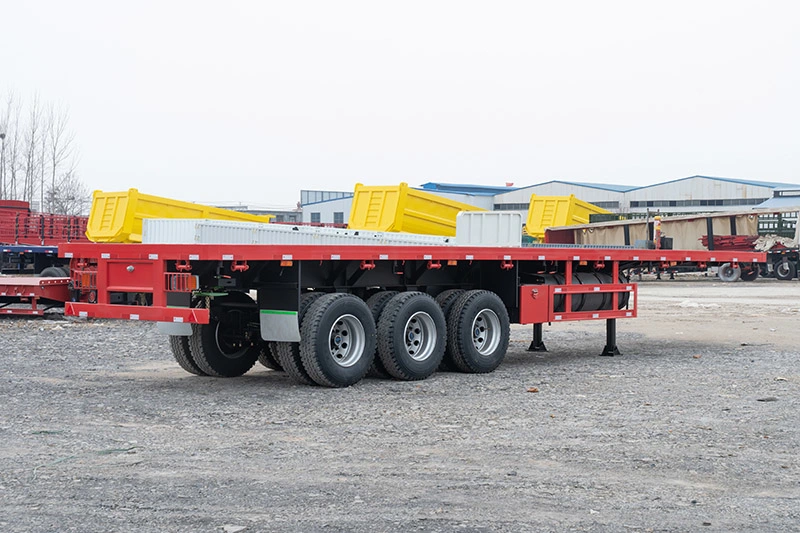
Welding is a crucial process in the manufacturing process of flatbed semi trailers. The quality of the welding points is directly related to the overall structural strength and safety of the vehicle. Therefore, properly handling the welding points of flatbed semi trailers can not only improve the performance of the vehicle, but also extend its service life. This article will introduce in detail how to handle the welding points of flatbed semi trailers to ensure that every connection is firm and reliable.
Preparation before welding
Before starting welding, make sure all welding materials and equipment are in good working condition. Choose the right welding rod and welding current to suit different metal materials and thicknesses. In addition, clean the welding area and remove oil, rust and other impurities to prevent pores and inclusions during welding.
Precise welding technology
When welding, it is crucial to use precise technology. Use appropriate welding speed and angle to ensure that the weld is uniform and defect-free. For large structural parts such as flatbed semi trailers, MIG/MAG or TIG welding technology is usually used to obtain high-quality welds.
Inspection and treatment after welding
After welding, thoroughly inspect the weld to look for possible cracks, pores or lack of fusion. Use appropriate inspection tools, such as magnifying glasses, magnetic particle inspection or ultrasonic inspection, to ensure the quality of the weld. For problems found, repair them in time.
Grinding and painting of welding points
In order to improve the aesthetics and corrosion resistance of welding points, the welds need to be polished to make their surface smooth. After grinding, apply anti-rust primer and topcoat to protect the welding points from the external environment.
Regular maintenance and inspection
Even if the welding points are properly handled in the initial stage, the flatbed semi trailer needs to be maintained and inspected regularly. Especially in harsh working environments, welding points may be subject to additional pressure and wear. Regular inspections can detect problems early and avoid potential safety hazards.
Conclusion
Proper handling of the welding points of flatbed semi trailers is the key to ensuring vehicle safety and performance. Through careful preparation, precise technology, strict inspection, meticulous grinding and painting, and regular maintenance, we can ensure that every flatbed semi trailer has a strong and durable structure. While pursuing efficiency, we should pay more attention to quality, because this is a manifestation of responsibility for every driver and cargo.